This will be the last year you'll be able to buy a Mercedes C-Class sedan with an engine — at least for a while. Next year, the C-Class sedan will come only with a battery (and electric motors) — at least for a while.
Sometime after the new, battery-powered C-Class appears for the 2027 model year, Mercedes will offer its entry-level small sedan with an engine again.
This year will be the last year the C-Class comes only with an engine — and in its current configuration.
What It Is
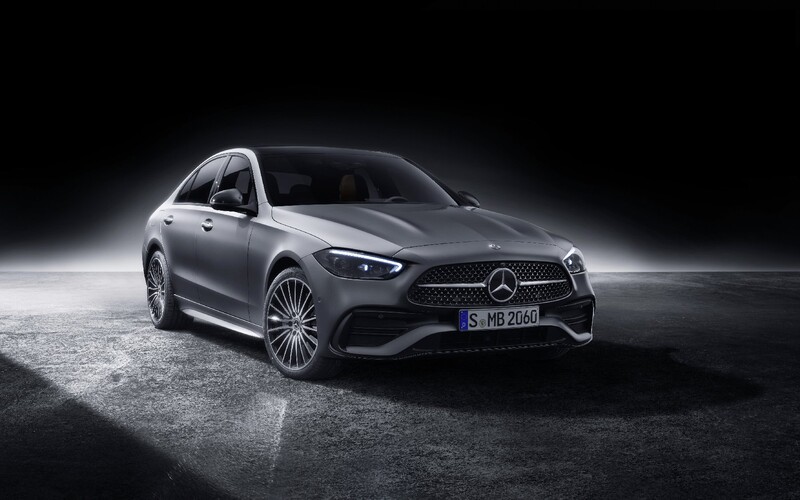
The C-Class is Mercedes' entry-level small sedan. It broke convention when it was last redesigned back in 2023, when it switched from a rear-wheel drive to a front-wheel drive layout. It was a risky move, because FWD is generally the way lower-priced, less-prestigious cars such as Toyotas and Hondas are laid out. Not that there is anything wrong with FWD. Among other benefits, you're less likely to get stuck in the snow in a FWD car, because traction is better with the engine's weight on top of the primary drive wheels, and also because you have more traction when the front wheels are pulling rather than the rear wheels pushing, but (again) it is less prestigious because it's the layout you get in Toyota and Hondas and pretty much all other non-luxury-brand vehicles.
On the other hand, Audi has not had any trouble selling its FWD-based vehicles, and the same goes for Lexus. Mercedes saw this and decided to run the risk — and it paid off. The FWD/AWD C-Class has been a success for Mercedes — and part of the reason probably has to do with it being FWD, because the layout makes it possible to carve out more interior space (because most of the drivetrain is up front rather than under the floorpans), which matters a lot in the case of a small car.
Prices start at $49,650 for the C300, which is FWD as it comes but can be had with AWD — which Mercedes calls 4Matic — which bumps the price up to $59,650. With — or without — the 4Motion AWD, you get a turbocharged 2.0-liter engine paired with a nine-speed automatic. Plus a sunroof, dual-zone climate control, rain sensing wipers, wireless phone charger, seat heaters up front and a dual-screen main instrument cluster and secondary infotainment screen.
You can opt for an Exclusive Package ($2,250) that adds a Burmester premium audio system and integrated navigation. A $4,150 Pinnace Package adds an even better 15-speaker, 3D surround sound Burmester system, plus acoustic side glass, LED projector headlights and other upgrades.
If you want more performance, the $64,150 C43 AMG comes with a much more powerful version of the 2.0-liter engine, standard AWD, sport tuned suspensions, sport buckets and a rear-wheel steering system.
Mercedes also offers a C63 iteration of the C-Class. The "C63" designation once meant a massive V8. It now means a massively powerful, plug-in-hybrid augmented version of the 2.0-liter four that makes almost three times as much horsepower as the base 2.0-liter four and an astounding 752 foot-pounds of tire-roasting torque. This model also gets a four-wheel torque distribution system with Drift mode that lets you wag the car's tail in the curves. High-performance Brembo brakes are also included.
What's New for 2026
Other than minor trim shuffling, the C-Class enters its last year before the big makeover that's coming next year pretty much the same as it was last year.
What's Good
— Still has an engine — for now.
— Roomy in both rows.
— Optional turbo fours make V8 (and V12) power.
What's Not So Good
— Tiny trunk (11.6 cubic feet).
— Pricey — especially relative to rivals such as the Genesis G70 sedan, which stickers for just $43,450 and is RWD and comes standard with a larger (2.5-liter) much stronger engine too.
— As powerful as the C63's four is, it's still a four.
Under the Hood
Every C-Class sedan comes with a turbocharged 2.0-liter engine — but in three different configurations. The version that powers the C300 and C300 4Matic is paired with a mild hybrid system that's mostly there to allow the engine to be shut down when possible to increase gas mileage and (more important, for the manufacturer) reduce CO2 coming out of the tailpipe. The hybrid side powers accessories when the engine has been cycled off. It automatically cycles back on as needed. The main upside — for the owner — of the mild hybrid setup is that the frequent engine restarts are hardly noticeable, due to the higher torque of the starter system.
Power is pegged at 255 horsepower and 295 foot-pounds of torque, which is enough to get the C300 to 60 mph in about six seconds. Gas mileage is 25 mpg city, 35 mpg highway — close to economy car gas mileage in a luxury sport sedan. A nine-speed automatic is standard and — as already mentioned — you can go FWD or (optionally) 4Matic AWD.
The high-performance C43 gets a more powerful iteration of the C300's drivetrain. Horsepower jumps to 416, and torque goes up to 369 foot-pounds. These numbers are on par with what you'd expect to get out of a 5.7-liter V8 — and so is the performance. This version of the C-Class sedan can get to 60 mph in 4.3 seconds. It still manages to tout 19 mpg city, 27 mpg highway.
AWD is standard with the C43.
Then there's the C63. As mentioned earlier, this designation used to mean a big V8 in a small sedan. Now it means a small four that's much stronger than the big V8 you used to get. Paired with a plug-in hybrid adjunct, the 2.0-liter four is capable of producing 671 horsepower and 752 foot-pounds of torque. This thing can get to 60 mph in 2.9 seconds, making it just about the quickest new car you can buy — at any price.
Though gas mileage is probably not a factor when you're spending $88,000 on a car, the C63 posts 19 mpg city, 22 mpg highway — which is much better mileage than the old V8 C63 managed.
Both the C43 and C63's engines come signed by the guy who assembled them on the AMG line.
The C63's engine is also almost pornographically displayed. As such things ought to be. Because they are worth looking at.
On the Road
The C feels bigger than it is, chiefly because there's more room inside than you might expect to have inside a car this size. It also does not feel FWD, which matters a lot in a car this expensive.
Mercedes did a lot of work to make it not feel like a Honda Civic or Toyota Corolla (which are about the same size). Torque steer — the tendency of the front wheels to jerk left-right during hard acceleration from a standstill — is muted completely by the electronic controls. 4Matic (AWD) models obviously haven't got any torque steer worries at all because power is routed to all four wheels, so that none slip or jerk.
In this Mercedes, a 2.0-liter four is not at all out of place.
Or, more precisely, out of price. It arguably is in the midsize (and nearly $20,000 more expensive to start) E-Class sedan, which used to come standard with a 3.5-liter V6. The current (2026) model comes standard with the same 2.0-liter four that comes standard in the C300. That means you get the same engine — and better performance, due to the C being smaller than the E — for that much less, which is inarguably good for the C buyer but a bit disappointing if you are an E buyer.
The nine-speed automatic is a key differentiator versus four cylinder-powered/FWD non-luxury-brand small sedans that mostly (there are few exceptions) come standard with continuously variable transmissions, which feel "slippy" sometimes and often sound not so great too.
The C43 is a sleeper.
It does not look like it can out-accelerate a muscle car — but it can. The C63 can outrun just about anything, including the quickest EVs, such as the Tesla S plaid. And it goes farther than any of them, because it carries around a tank of gas as well as an engine that can charge up its batteries while you drive.
The one detraction — if it is one — is the car's firm ride. "Firm" is of course subjective, and that's why it's not necessarily a detraction. It all depends on whether you like "firm." Some will — some won't. The only way to know is to spend some seat time in the car and see for yourself.
At the Curb
The C-Class sedan is (per above) impressively roomy inside given its compact dimensions. It is 187 inches long — so only a few inches longer than a Toyota Corolla — but it has midsize car rear-seat legroom (36 inches), which makes it comfortable for four adults and viable for five (three in back). The third person in back doesn't have to scrunch up their legs into the fetal position, either — because the centerline hump in this car is not as high as it is in RWD cars, to accommodate the driveshaft that runs from the engine up front to the rear wheels out back.
However, this small car has a very small (11.6-cubic-foot) trunk, and that impinges on its practicality. As a point of comparison, the Corolla has nearly 14 cubic feet of space in its trunk.
That small issue aside, the C offers — comes standard with — luxuries befitting its price, and while some of these (such as the big LCD touch screens, smartphone charger pad, sunroof and adjustable ambient interior lighting) have become standard or at least available in most non-luxury-brand sedans, there are still things you can get in this Benz that you can't in the non-luxury-brand sedans, such as the available 15-speaker, 3D surround-sound Burmester audio system, the acoustic side glass (which greatly lessens outside/road noise intrusion) and the augmented reality map overlay for the nav system.
You can also get some of the AMG (C43 and C63) looks as well as some of the goods without buying the more powerful (and much more expensive) drivetrains. The AMG Line package ($2,750) includes special black-anodized wheels, sport-tuned suspension and more aggressive steering feel, plus painted calipers and vented brake rotors, sport buckets and brushed aluminum pedals, among other upgrades.
The Rest
Next year — 2027 — the C-Class will be remodeled and (initially) will come only with an electric drivetrain. Some may want to wait for that. Others may want to hurry down to their closest MB store to buy a current C-Class before the transition occurs.
Or you could wait until later in 2027 (or early early 2028), when Mercedes will add an engine option to the roster.
The Bottom Line
Small luxury sedans have the merit of being sort of affordable luxury sedans. If this one had a bigger trunk, it'd be an almost $20,000 alternative to the midsize E-Class sedan. Given that the E sedan doesn't have a much bigger trunk (just 12.7 cubic feet) or much more interior space — or a bigger engine — the C sedan kind of already is just that.
Eric's latest book, "Doomed: Good Cars Gone Wrong!" will be available soon. To find out more about Eric and read his past columns, please visit the Creators Syndicate webpage at www.creators.com.
View the Mercedes C-Class sedan this week.






View Comments